

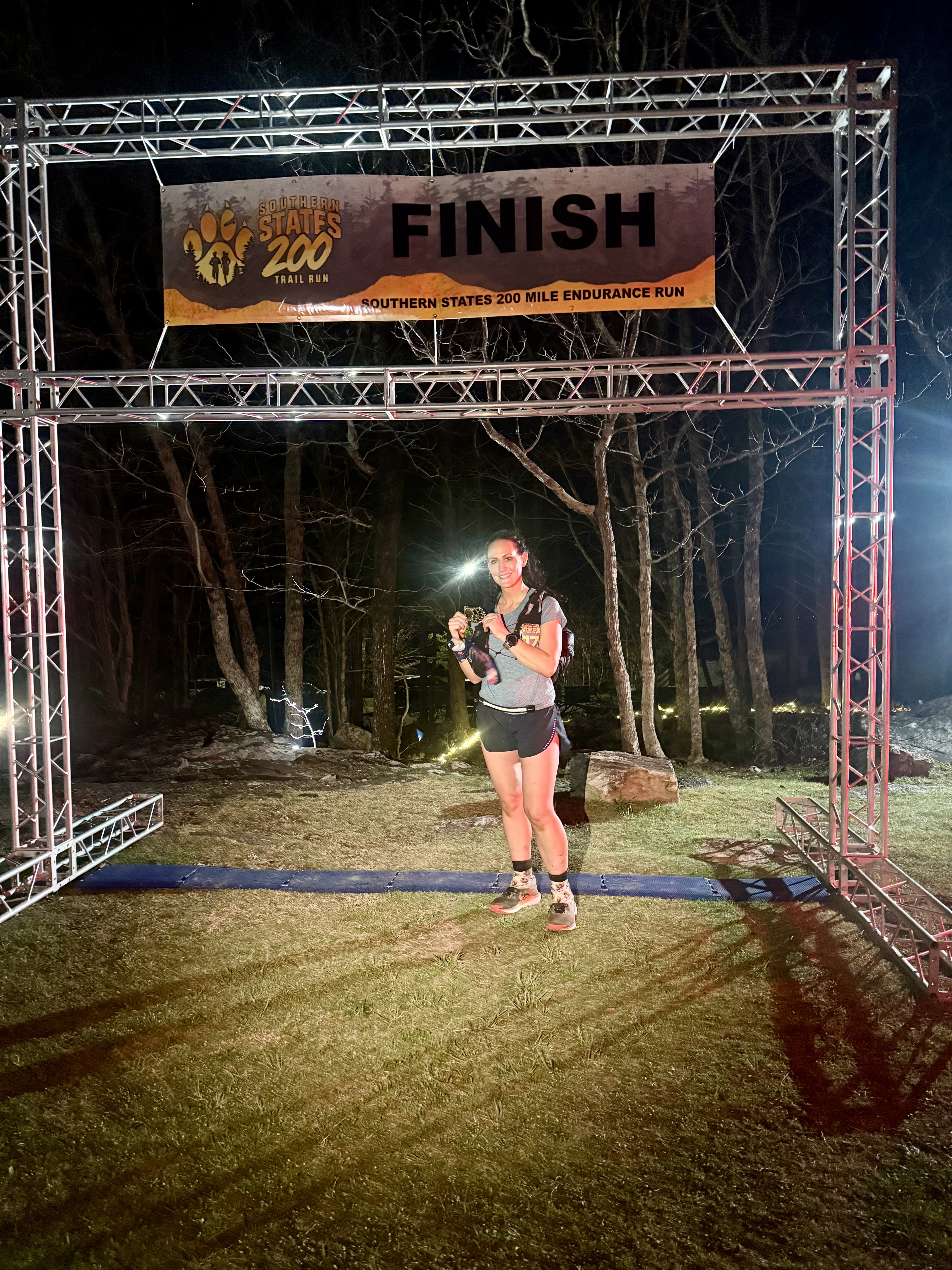
I’ve never been to the South. I’m a true and tested West Coaster with the miles of forest trails and waterfall photos to prove it. So when Southern States 200 appeared on my radar, 200 miles through Georgia and Alabama, it stood out as something very different and very out of my comfort zone. My current goal is to explore new areas, see new things, and enjoy new adventures by foot. That meant packing my bags for terrain I’d never set foot on.
Being from Oregon, not a single friend was remotely interested in joining me in Alabama or Georgia. I wasn’t shocked. And honestly, it presented an opportunity: I would do this one solo. No crew, no pacers. It would be the first race of this magnitude, really any magnitude, where I’d be completely on my own.
Weeks before the race, I meticulously packed my drop bags. With 16 aid stations on the course, I spaced my bags roughly every other station, adjusting for variable distances between them. Each bag was packed differently based on my rough prediction of when I’d roll through. Three bags contained night gear and extra headlamps. Two had basic foot care and nutrition refills. Others held day gear, backup chargers, and headphone backups. I chose bright, obnoxious bags on purpose: to make me smile when I spotted them, and to bring a little joy to the volunteers.

Uncrewed runners were asked to stay in Oxford, Alabama on Monday night, then meet at the finish line at Cheaha State Park the following day at noon to catch a shuttle to Dalton, GA, where we’d overnight before being shuttled to the start. That shuttle would turn out to be pivotal to my race. About seven of us stood awkwardly at Cheaha with drop bags in hand, filling the silence with chatter about previously completed 200-milers. I made my rounds introducing myself, asking people where they were from, a detail that became how I’d refer to everyone for the rest of the race. Here comes Michigan!
On the shuttle I got to know a few runners more: two from Michigan, one from my home state of Oregon, others from Pennsylvania, Virginia, Canada, and Washington. A ragtag crew of fairly proficient 200-mile athletes.
Once we landed in Dalton, we checked in and settled into the hotel. I spent the night chasing as much sleep as I could bank before the start.
At 11am the shuttle picked us up and drove us a couple miles down the road to the start line at a small roadside shop. The crewed athletes arrived with full teams and gear, dwarfing the uncrewed contingent. The undisputed highlight of the start area: four kittens tumbling and playing in the chaos. It eased the tension and filled my fluffy animal cup completely.

At noon, with the shot of a LITERAL gun, the race started.

As all races do, this one started fast and aggressive, out on the street, running uphill immediately. I knew within the first few minutes this was going to be a reckoning. I’d come into the race on the back of a full month off due to a respiratory infection, and my lungs were already reminding me of that fact. I pulled back, settled into a comfortable pace, and repeated my mantra: the ego is the enemy. I wasn’t here to compete. I was here to learn and grow as an athlete.
The first 16 miles were relatively unremarkable, road and forest trail leading to a parking lot aid station where I adjusted a piece of tape on my ankle and kept moving. From there, winding forest trails wound past Georgia waterfalls and climbed granite stairs to beautiful overlooks. The trails were rocky but runnable, smooth enough that you could move without worrying about catching something hidden underfoot. That would change later.

The next aid station came at mile 26, perched at an overlook where, because of our noon start, the sun had begun to set. The sky was stunning. I grabbed some warm quesadillas, shoved them in my pocket, and descended a jeep road before the tree canopy swallowed us again.

The following section, about 14 to 15 miles, was cruisy and smooth. But the sun disappeared entirely, and lights became necessary. In true form, both my headlamps were dead. Charged and checked before the race, somehow dead now. I made do with a nearly useless backup light and my iPhone, knowing another aid station wasn’t far off.
Dry Creek Trailhead arrived quickly, and I was thrilled to see my bright pink unicorn drop bag waiting for me. I got to work: changed my socks, packed fresh lambs wool around my feet, touched up tape. The volunteers were incredibly kind. The race director herself was there, and they acted as my personal crew, filling my pack and handing me mashed potatoes inside a bowl of ramen while watching in mild fascination as I pulled tufts of lambs wool from a bag and wrapped them around my toes. Foot care is life in a 200-mile race.
The next stretch was supposed to be about 12 miles to a water-only drop, then another nine to the next full aid station. A long time between stops. Fortunately I’d picked up a new trail friend, and we navigated the dark together. I noticed I was peeing more than I wanted to and made a mental note to get more salt in immediately. The trail was cruisy and runnable but climbed well. Being the first night, I still felt energized and genuinely happy to be out there.
Then we hit the river crossings. I knew they were on the course and had brought cast covers for my legs. What I didn’t expect was how many there were, or how deep. I made the mistake of putting the covers away too soon, not realizing the deepest crossing was still ahead. Quad-deep water, and with a small puncture in one cover, I got a slight leak. But mostly those things were an absolute lifesaver. My feet and pants came through nearly dry.

At one point a fighter jet flew over us at what felt like only a couple feet above our head. 12 miles in I At one point, a fighter jet screamed overhead at what felt like fifty feet above us. Just a Tuesday in the woods.
Twelve miles in, I was genuinely thrilled to spot the water jugs on the side of the trail, just to sit down for a moment and breathe. I parted ways with my trail friend there and linked up with two new ones, which kept the energy going until we reached Mack White Trailhead.
At this aid station I had my lunch box with my puppy’s face on it and a sweet ten-year-old girl assisting me. I touched up my feet, ate what I could, and got moving. Except I left my poles behind and had to double back. Classic. The section out of there started with a climb up a jeep road, and in my mountaineering jacket, I overheated almost immediately. I also spotted my first snake here: a big one, thankfully dead, coiled at the side of the trail.

Nine or so miles to High Point, GA, but not before going off course and tacking on an extra mile. Rolling terrain, full sun, podcast episodes blurring together. Once I hit the aid station I changed into daytime clothes and pulled on my bright pink Nike shorts, knowing road miles were coming.
I was told the next section was runnable and fun on rail tracks. It was neither. Sunken trail trenches forced me to run up the banks on both sides to avoid soaking my feet. Angry dogs guarded every rural property along the route. And what I thought was nine miles was actually twelve or thirteen. I was hot and cranky by the time I limped into Huffaker Road Aid Station.
A quick drop bag stop: touched up the feet, doused myself in sunscreen, topped off the water bladder. In my delusional mind I figured 20 miles of road would be quick because it was flat and it was road. Spoiler: it was neither flat nor quick. The roads climbed aggressively. A long stretch ran along a four-lane highway where logging trucks blew past close enough to knock you sideways, debris pelting you from the shoulder. Other sections had no shoulder at all, just constant diving off the road edge to avoid getting clipped. Apparently in Georgia, moving over for runners is not a cultural norm. It was mid-day, it was hot, and somewhere in that stretch, I cried. By the time I reached Cave Spring, a genuinely charming little town, my feet were screaming and I was ready for a nap.
I crawled into the sleep tent with a few other runners and fashioned a pillow out of a sleeping bag. Bundled in night gear and my mountaineering jacket, I was still freezing. After a few minutes of almost-dozing, I gave up and accepted it wasn’t going to happen. Lights on. Into the second night.
The first portion felt okay. I stopped in at the next aid station, had a snack, chatted with volunteers, and headed out.
What followed would prove to be the hardest section of the course. It started fine but quickly devolved into a maze of rocks and nearly impossible-to-find trail flags. At one point I simply sat down and waited for the runner behind me to catch up so we could problem-solve together. Much easier, much more fun, but still painfully slow. At some point we crossed from Georgia into Alabama, marked by flags on the trail that gave me a genuine little thrill. After hours of technical hiking, we popped out on a road and, with the enthusiasm only ultra runners at mile 115 can muster, cursed our way into the next aid station. I changed back into daytime clothes because that is how long that section had taken.

The next few sections blend together of winding wooded trail seemingly going up and down the same dang steep hill. And covered in loose dead leaves and long sections of big bundles of slippery pine needles. This was a relentless section and I was so grateful to be with my new friend, Shannon the whole time. By the end of our long multi sections together, we caught up with our other crew-less friend, Mark and hiked into the Hilltop Blue Aid Station, which was indeed at the top of a hill.
Shannon, being the smart one, stopped to sleep. I changed my foot gear, decided it was too loud and bright to rest, and headed back out feeling good. That didn’t last long. Night fell, the night monsters hit hard, and I resorted to trail naps: unpack the jacket, put it on, use the pack as a pillow, sleep fifteen minutes until the cold woke me. Repeat three or four times.
I hit another stretch of river crossings, back and forth across the same river, and again waited for friends before tackling them together. That company gave me enough energy to wind around a lake and into the next aid station, where most of my group settled in to sleep. I briefly considered pushing through with 15 miles ahead in the next section, but talked myself into a 40-minute power nap first. Still wasn’t enough. I stumbled back out tired and fighting sleep demons. It took me an embarrassingly long time to remember I had caffeine in my pack. One pill later, and I was a different person.
I cruised through to Fay’s Blowdown Aid Station. The barn was close now, about 20 miles to the finish. I got the best veggie burger of my life, a quick shot of motivation from my adopted crew, and touched up my feet one final time before heading out.
The last real section was relentlessly up and down, rhythmless and grinding. I ran into my second snake here, this one very much alive and not happy about it. A 100-miler spotted it first and flagged me down. I got past it on a burst of pure adrenaline. More river crossings. More winding, dry, up-and-down trail. But I was in striking distance, and all I had to do was keep moving and have fun.
As night descended again, I hit the final aid station where my ten-year-old friend from earlier, along with her siblings, fed me pizza and sent me off with a cheer.

The climb up Mt. Cheaha buzzed with a kind of quiet electricity. Compared to Oregon climbs it was nothing, gentle and steady, and I danced and sang my way up. The darkness made it feel endless. I couldn’t tell how high I was or whether I was still climbing. A few sections had significant drop-offs to the side, but fatigue had dissolved any fear I might have felt. I just kept moving.
Finally, I saw the boardwalk. I’d heard about it on podcasts. The end was real. I turned off my music and listened for cheers.
Around midnight, I crested the mountain and followed a light-streamed trail to the finish line. For midnight, there was a surprisingly warm crowd cheering. The race director wrapped me in a big hug. I was handed a beautiful gold belt buckle, a plate of veggie lasagna, and found a spot in the lodge to watch as the other finishers made their way across the line one by one.
Overall, this was a deceptively hard race. Low elevation change does not mean easy. The trail technicality was treacherous, the uniform sameness of the terrain was mentally exhausting, and the road sections were genuinely dangerous. But the volunteers and race directors were absolutely top-notch, and the community of runners I fell into made the whole thing possible.
I won’t be back for this one. But I can’t speak highly enough of the people who put it on.

Leave a Reply